


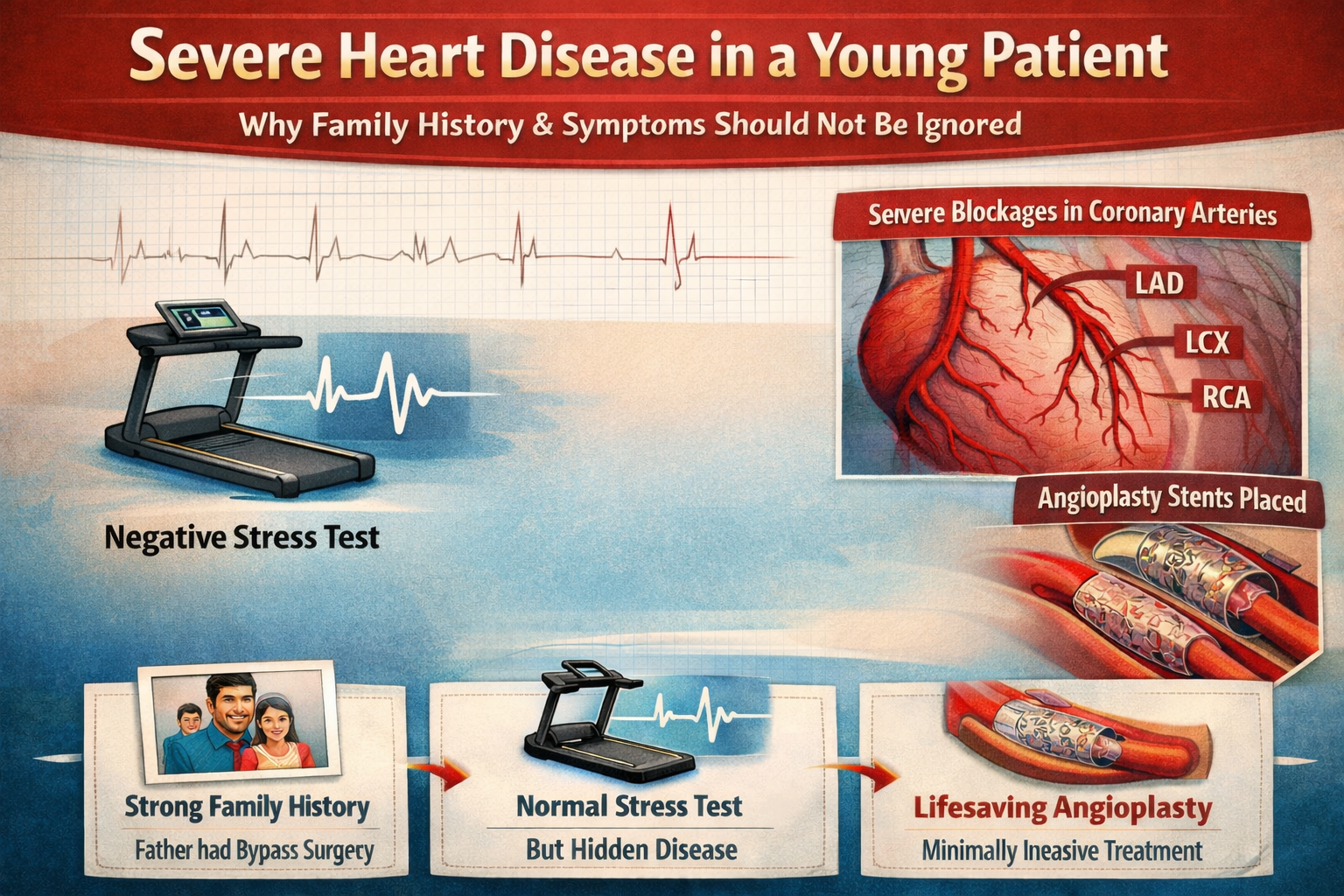
Heart disease is commonly associated with older individuals, but cardiologists are increasingly seeing serious coronary artery disease in younger patients.
A recent case managed by Dr. A. Sreenivas Kumar highlights an important lesson in modern cardiology — never ignore symptoms and family history, even when initial tests appear normal.
This case of a 36-year-old man with severe triple vessel coronary artery disease despite a negative stress test shows why clinical judgment and detailed history taking remain essential in cardiac care.
A Young Patient with Typical Angina Symptoms
A 36-year-old male business professional presented with chest discomfort that had been troubling him for nearly three months.
The pain had classic features of angina, including:
-
Chest tightness during exertion
-
Pain radiating to the left arm and fingers
-
Discomfort triggered by physical activity
These symptoms raised suspicion of reduced blood flow to the heart muscle, even though the patient was relatively young.
Risk Factors Identified
Further evaluation revealed several important cardiovascular risk factors:
-
Recently diagnosed high blood pressure
-
Elevated cholesterol levels
-
Strong family history of premature coronary artery disease
Laboratory investigations showed:
-
Total Cholesterol: 255 mg/dL
-
LDL Cholesterol: 165 mg/dL
Other routine blood investigations were normal.
Why Family History Was a Critical Clue
One of the most important aspects of this case was the patient’s family history.
His father had suffered from severe triple vessel coronary artery disease and required bypass surgery (CABG) nearly 15 years ago in the United States.
Such a strong family history raises suspicion of Familial Hyperlipidemia (FHL) — a genetic disorder that causes extremely high cholesterol levels and early heart disease.
People with familial hyperlipidemia often develop serious coronary blockages at a much younger age.
young male story copy copy (1)
Because of this history, doctors remained cautious even when early test results appeared reassuring.
Initial Cardiac Tests Appeared Normal
The patient initially underwent several cardiac tests.
Initial investigations
-
Electrocardiogram (ECG): Normal
-
Echocardiography: Normal heart function
-
Treadmill Test (TMT): Reported negative for ischemia
Normally, a negative treadmill test suggests no significant blockage affecting blood supply to the heart during exercise.
However, the patient continued to experience exercise-induced chest pain, which suggested something was not right.
Why Stress Tests Can Sometimes Miss Heart Blockages
Although treadmill stress tests are widely used to detect coronary artery disease, they are not always perfectly accurate.
In some cases, patients may have false-negative results.
One possible explanation is balanced ischemia.
Balanced ischemia occurs when multiple coronary arteries have severe blockages. Since blood flow is equally reduced in several regions of the heart, the ECG changes that normally indicate ischemia may not appear clearly.
As a result, the test may appear normal even though serious coronary disease is present.
This is why cardiologists always consider clinical symptoms and patient history alongside test results.
Mother’s Concern Led to a Life-Saving Consultation
An interesting and important turning point in this case came from the patient’s mother.
Because she had previously witnessed similar symptoms in her husband before his heart surgery, she became concerned when her son continued to experience chest pain despite a negative stress test.
She decided to bring him to Apollo Hospital for evaluation by Dr. A. Sreenivas Kumar.
This decision ultimately proved life-saving.
Coronary Angiography Revealed Severe Blockages
Considering the patient’s symptoms and family history, doctors recommended coronary angiography.
Coronary angiography is a specialized imaging procedure that allows cardiologists to directly visualize the coronary arteries and detect blockages.
The results were surprising.
The angiogram revealed severe triple vessel coronary artery disease, meaning three major coronary arteries supplying the heart were critically blocked.
The affected arteries included:
-
Left Anterior Descending artery (LAD)
-
Left Circumflex artery (LCX)
-
Right Coronary Artery (RCA)
Advanced Treatment with Multivessel Angioplasty
Because the patient had severe blockages in multiple arteries, treatment was required immediately.
Instead of open-heart surgery, doctors performed Multivessel Percutaneous Coronary Intervention (MVPCI) — an advanced minimally invasive angioplasty procedure.
Steps of the Procedure
The procedure involved treating multiple arteries:
-
Stenting of the LAD artery
-
Balloon angioplasty to restore blood flow in the diagonal branch
-
LCX / OM artery angioplasty and stenting
-
RCA stent placement
These procedures successfully restored blood flow to the heart.
Managing a Temporary Complication
During the procedure, the patient developed occlusion of a diagonal branch artery, which caused chest pain and ECG changes.
The cardiology team quickly intervened and performed balloon angioplasty to reopen the blocked vessel.
Blood flow was successfully restored, and the final angiographic result was excellent.
Post-Procedure Medical Management
After the procedure, the patient was started on comprehensive medical therapy.
Medications included
-
Dual Antiplatelet Therapy (DAPT)
-
Ticagrelor
-
Aspirin
-
-
High-dose statin therapy
-
Nicorandil
-
PCSK9 inhibitor injection immediately after PCI
Additionally, the patient was started on Inclisiran injections every six months to aggressively control cholesterol levels.
Follow-Up and Patient Outcome
At the first follow-up visit, the patient was:
-
Completely symptom-free
-
Able to resume normal daily activities
-
Maintaining stable heart function
His family was extremely happy with the outcome.
Interestingly, unlike his father who required open-heart bypass surgery, this young patient was successfully treated using minimally invasive angioplasty techniques.
Key Lessons from This Case
This case offers several important insights for patients and healthcare providers.
1. Never Ignore Persistent Chest Pain
Chest pain radiating to the arm or jaw should always be evaluated carefully.
2. Family History Matters
A strong family history can significantly increase the risk of early heart disease.
3. Stress Tests Are Not Perfect
A negative stress test does not always rule out coronary artery disease.
4. Angiography Is the Gold Standard
Coronary angiography remains the most accurate method for diagnosing coronary artery blockages.
5. Modern Angioplasty Can Treat Complex Disease
Advances in interventional cardiology now allow doctors to treat even complex multivessel disease with minimally invasive procedures.
FAQs
1. Can young adults develop severe heart disease?
Yes. Genetic conditions such as familial hyperlipidemia can cause serious coronary artery disease even in people in their 30s.
2. Why was the treadmill test negative despite severe blockages?
This may occur due to balanced ischemia, where multiple arteries are blocked equally, preventing typical ECG changes.
3. What is triple vessel disease?
Triple vessel disease refers to significant blockages in three major coronary arteries supplying the heart.
4. Is angioplasty safer than bypass surgery?
For many patients, angioplasty is less invasive and has faster recovery, but the best treatment depends on the severity of disease and patient factors.
5. What are PCSK9 inhibitors?
PCSK9 inhibitors are advanced cholesterol-lowering medications that significantly reduce LDL cholesterol levels and prevent future heart attacks.
Conclusion
This case is a powerful reminder that clinical history and patient symptoms remain central to accurate diagnosis.
Even when tests appear normal, persistent symptoms and strong family history should never be ignored.
Thanks to timely intervention and advanced cardiology techniques, this young patient with severe triple vessel disease was successfully treated and is now leading a healthy life.
————————————————————————————————————————————————–
About Dr. A. Sreenivas Kumar
Dr. A. Sreenivas Kumar is a highly experienced Interventional Cardiologist based in Hyderabad, with over 20 years of experience in managing complex heart conditions. He holds qualifications in MBBS, MD (General Medicine), and DM (Cardiology) and is also a FACC Cardiologist.
He is widely recognized for his expertise in TAVI/TAVR, complex coronary interventions, and advanced cardiac care. Dr. A. Sreenivas Kumar has successfully performed 15,000+ angioplasties and 100+ TAVI/TAVR procedures, making him one of the trusted names in interventional cardiology in Hyderabad.
Hospital Association:
Apollo Hospitals, Jubilee Hills, Hyderabad
Consultation Timings:
Clinic Timings: Monday to Friday, 10:00 AM to 03:30 PM
Online Timings: Monday to Friday, 02:30 PM to 03:30 PM
Book Consultation:
Patients can book a video consult or hospital visit for expert heart care, second opinions, and advanced treatment guidance.